Seven Drafts of a Sentence: How My Bio Finally Learned to Tell the Truth

The first bio I ever wrote described me, in part, as a "multidisciplinary storyteller with a passion for elevating brand narratives." I was twenty-four. I had elevated exactly zero brand narratives. I had, however, read a lot of agency websites, and I had absorbed their dialect the way anyone absorbs a language spoken around them daily.
What I did not understand at the time is that a bio is the hardest creative brief you will ever take on. There is no client to interview, no audience research to lean on, no brief but yourself — and yourself is the subject you know just well enough to misrepresent convincingly.
Version One Through Four: The Inflation Years
Draft one was the agency-speak version above. Draft two, written when I went freelance, got worse before it got better. I added the word "sought-after," which is a word nobody has ever used to describe themselves truthfully. Draft three introduced a list of skills so long it read like a panic attack formatted in bullet points. Draft four was my favorite failure: I hired it out. I paid a copywriter — a good one — to make me sound impressive, and she did. It was polished, persuasive, and completely unrecognizable. A recruiter I'd hired for a mock review read it and said, "She sounds great. Who is she?"
That question stung because it was the same one I'd been avoiding. I didn't know who she was either.
The Draft That Broke Me Open
Version five arrived after a project fell apart — a collaboration that ended badly, partly because the person on the other end had hired the bio, not the person. When it collapsed, I sat down to update my website and found I couldn't write a single sentence I believed.
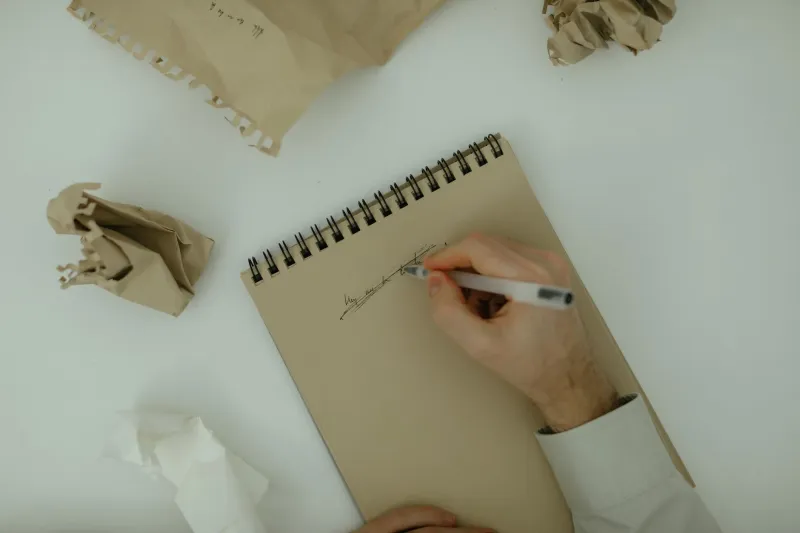
So I tried something backwards. Instead of writing what I wanted people to think, I wrote what I would actually say if a friend asked what I do at a kitchen table. No audience. No recruiter in my head. Just the plain truth: I write things, I help other people shape their ideas into finished work, and I'm good at deadlines.
It was three sentences. It made me cringe precisely because it contained no armor.
Version Seven, or: The Two-Sentence Bio
The version that lives on my site now is two sentences long. It says what I do, who I do it for, and one concrete thing I've made. That's it. No adjectives survive in it. I cut them the way you cut a darling from a manuscript — reluctantly, then with relief.
Here is what I learned in the space between draft one and draft seven: the adjectives were never describing me. They were describing my fear. "Passionate" meant please take me seriously. "Experienced" meant I'm worried I'm not. "Multidisciplinary" meant I don't know what I am yet. Once I saw the pattern, I couldn't unsee it, in my own writing or anyone else's.
An Exercise: The Adjective Interrogation
If your bio makes you slightly embarrassed, try this. It takes twenty minutes.
-
Print your current bio and circle every adjective and adverb. Every one. "Strategic," "creative," "detail-oriented," "seasoned." Circle them all.
-
For each circled word, ask: what evidence would prove this? If you can point to a project, a number, a named result — replace the adjective with that fact. "Detail-oriented" becomes "delivered 40+ issues of a weekly newsletter without a missed deadline." If you cannot find evidence, the word is decoration, and decoration in a bio reads as doubt.
-
Read what's left aloud, to one person. Not a peer in your industry — a friend with no context. Note the moment their face asks a question. That's where you're still writing for an imaginary critic instead of a real reader.
-
Cut until it fits in two sentences. Not because short is inherently better, but because length in a bio is usually a symptom of hedging. Say the true thing; it takes less room than the evasive version.
What Changed When the Bio Stopped Lying
I expected the honest version to cost me opportunities. Instead it filtered them — and filtering turned out to be the point. The inquiries that came afterward were from people who wanted the actual work, not the pitch. One client later told me she'd chosen me because my bio "sounded like a person." That's a strange compliment until you realize how rare it has become.
A bio is not a sales document. It's a promise about what it's like to work with you, and promises only hold when they're specific. Mine took seven drafts to get there. Your mileage may be faster. But if you're on draft three, still reaching for "sought-after," I'll tell you what nobody told me: the sentence you're embarrassed by is usually the truest one on the page. Start there.